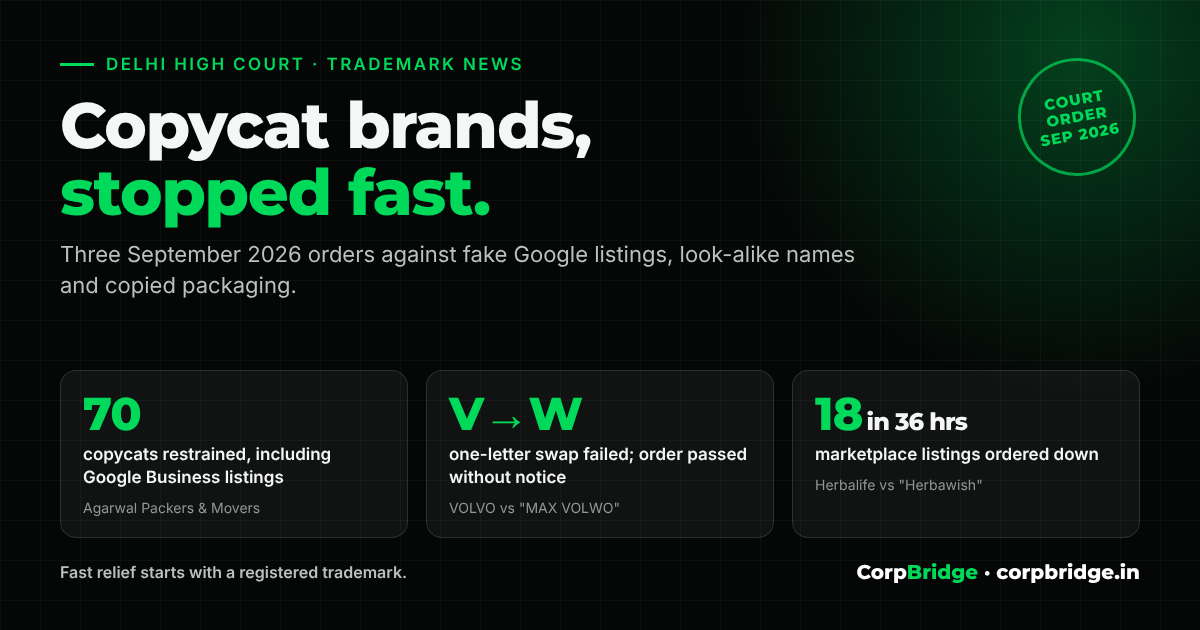
In three orders passed in September 2026, the Delhi High Court moved quickly against businesses copying established brands. It restrained 70 copycats from using the Agarwal Packers & Movers name, including on Google Business Profile listings; granted Volvo an injunction against 'MAX VOLWO' lubricants without first giving the seller notice; and, in Herbalife's case, ordered 18 'Herbawish' listings taken down from Amazon, Flipkart and IndiaMART within 36 hours. In each case, a registered trademark was the starting point for fast relief.
| Who is affected | Any business whose name, logo or packaging is being copied, especially service businesses listed on Google Maps and brands sold on online marketplaces. |
|---|---|
| What to do | Register your brand name, logo and packaging as trademarks, check Google Maps and marketplaces for copies regularly, keep dated evidence, and act quickly when you find misuse. |
| Source | Delhi High Court orders, September 2026 |
Copycat businesses rarely announce themselves. They show up as a Google Maps listing with your name and their phone number, a product with your name spelt one letter differently, or a marketplace listing in packaging that looks just like yours. In September 2026, the Delhi High Court dealt with all three, and in each case it acted quickly.
1. Agarwal Packers & Movers: 70 copycats, including fake Google listings
Order dated 22 September 2026 (CS(COMM) 1021/2026)
- The "AGARWAL PACKERS & MOVERS" mark had already been recognised as a well-known trademark, relying on a 2013 decree in DRS Logistics (P) Ltd v. Rajesh Agarwal. The owners had won recognition of their rights on five earlier occasions.
- The court accepted that copycat Google Business Profile and Google Maps listings are created and changed constantly, so a brand owner cannot realistically find every one of them.
- It found that using the mark in business listings for the same or similar services was likely to confuse and deceive the public.
- Defendants 1 to 70 were restrained from using the mark or any deceptively similar variant as a trademark, trade name, company name, search keyword or meta tag, or in any other way, expressly including Google Search and Google Business Profile listings.
Why it matters: For service businesses such as movers, clinics, coaching centres and travel agents, a fake Google listing quietly diverts customer calls and damages your reviews. This order shows courts will reach those listings directly.
2. VOLVO vs "MAX VOLWO": relief before the copycat was even heard
Aktiebolaget Volvo v. Pooja Lubricant, order dated 24 September 2026 (CS(COMM) 940/2026)
- The seller was selling engine oil and gear oil under "MAX VOLWO". The court held that swapping the "V" for a "W" made no difference: the marks look almost identical and sound the same.
- Adding "MAX", a word of praise, did not change the fact that "VOLVO" was the dominant part of the mark.
- The goods were identical (Class 4 oils), sold through the same channels to the same buyers.
- The court accepted that giving advance notice would defeat the injunction: the seller dealt in cash, held substantial stock, had moved away from its GST-registered address and could ship goods across states.
Why it matters: One-letter misspellings and added words do not get copycats off the hook. Where there is a real risk that stock will disappear, a court can grant relief before the other side is heard (an ex parte injunction).
3. Herbalife vs "Herbawish": 18 listings down within 36 hours
Herbalife International v. Ashish Kumar, order dated 15 September 2026 (CS(COMM) 997/2026)
- The court found "Herbawish" and "Herbawish Nutrition" visually and phonetically deceptively similar to the registered HERBALIFE marks, with the shared "Herba" prefix making it worse.
- Copying of the trade dress, including the three-leaf device, colour scheme, white container, green band and label layout, pointed to dishonest intent.
- Because these are nutrition products, the court noted that poor-quality imitations could also put public health at risk.
- It granted an interim injunction without notice, and Amazon, Flipkart and IndiaMART were directed to take down 18 listings within 36 hours and disclose the sellers' KYC details.
Why it matters: Marketplaces act quickly on a court order, and the KYC disclosure tells you who is actually behind a listing, which is often the hardest part of stopping a repeat offender.
The three orders at a glance
| Case | What was copied | What the court ordered |
|---|---|---|
| Agarwal Packers & Movers | Name used by 70 businesses, including on Google listings | Restraint on all 70, covering Google Search and Business Profile listings |
| VOLVO vs "MAX VOLWO" | Brand name with one letter changed, on identical goods | Injunction granted without advance notice |
| Herbalife vs "Herbawish" | Similar name plus copied packaging | 18 marketplace listings down in 36 hours, seller KYC disclosed |
What brand owners should do now
- Register your brand name and logo in every class you trade in. A registration lets you sue for infringement, which is usually faster and simpler to prove than passing off.
- Protect your packaging too. A label or container design can be registered as a device mark, which helps when copycats imitate the look rather than the name.
- Check Google Maps and the major marketplaces for your brand name and close misspellings regularly. Take dated screenshots of anything suspicious.
- Keep proof of your use: invoices, advertisements and website records showing how long you have used the brand.
- Act quickly. Delay weakens the urgency courts look for before granting fast interim relief.
- If your brand is widely known, ask about having it recognised as a well-known trademark, which gives stronger protection across all goods and services.
How CorpBridge can help
Our experienced trademark agents can search for conflicting marks, file your trademark registration in the right classes, and help you oppose copycat applications before they are registered. Start with a trademark search to see what is already out there.
This is a plain-language summary for general information, not legal or tax advice. The court order or official document is the authoritative text. Ask an expert how it applies to you.